Multilingual Event Coordination Services
Conferences, public meetings and community events where the audience does not all speak English — run with the interpretation, equipment and translated materials that let every attendee take part in real time rather than read about it afterwards.
5.0 average rating on Google reviews Quotes returned same business day
 Certified GSA Schedule Holder
 - 300+ languages through 5,000+ vetted linguists, 24/7 support
- Multilingual events coordinated in all 50 states and the District of Columbia
How does multilingual event interpretation work?
Interpreters work from a soundproof booth or a tabletop booth, listening to the speaker through headphones and interpreting into a microphone. Each language is broadcast on its own channel to wireless receivers, and attendees select their language and listen through a headset. A full-day language pair normally needs two interpreters working in rotation. Hybrid and remote attendees receive the same channels through remote simultaneous interpretation.
An event people cannot follow is an event they did not attend
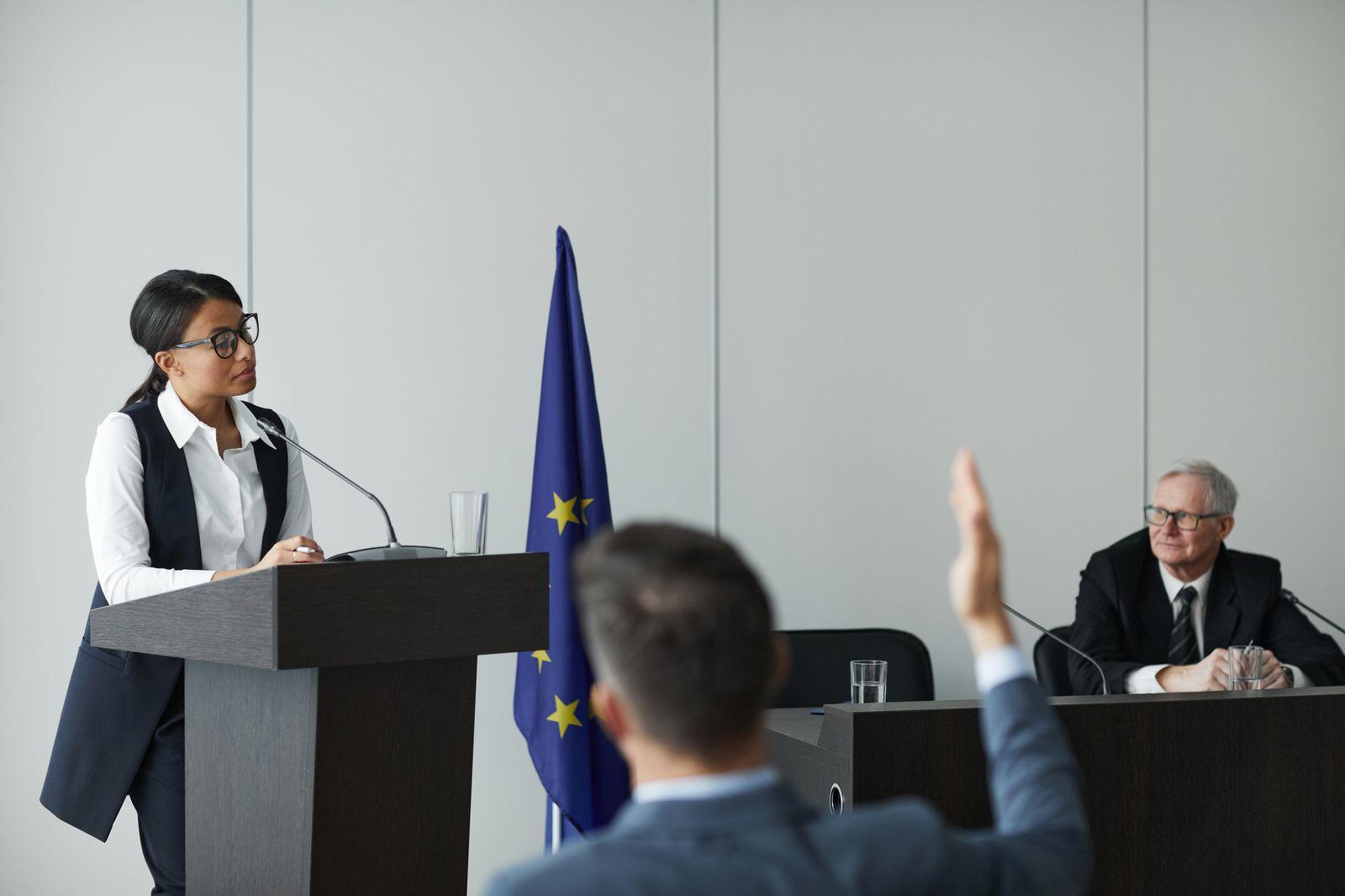
You can hold a public meeting in a room where a third of the community cannot follow the presentation, and it will look like a success. Attendance was good. The slides went up. Nobody complained, because the people who could not follow it also could not raise their hand about it. Then the decision gets made, the consultation is on the record as complete, and six months later it comes back as a grievance, a low turnout at the thing that mattered, or a Title VI complaint. For public bodies, meaningful access for people with limited English proficiency is a live obligation under Title VI of the Civil Rights Act — not a courtesy. And for everyone else, the arithmetic is simpler: you paid for a room, a stage and a speaker, and then let a headset budget decide how many people got the value.
Interpretation is what we do, not a service we resell
Taika Translations has run interpretation since 2009 — 102,000+ projects, 300+ languages, 5,000+ vetted linguists, 24/7 support, and a 5.0★ Google rating. We hold GSA Multiple Award Schedule 47QRAA18D00GT under category 541930 and a NASPO ValuePoint Master Agreement (40-00000-24-00076AJ); GSA's published description of that category names simultaneous, consecutive, escort, community and telephonic interpretation, plus the logistical coordination and quality control of those services. When you book a multilingual event with us, the interpreters are ours to brief and ours to answer for.
From attendee list to live interpretation
-
Tell us the languages — or ask us
If you know your community's languages, send them. If you do not, that is a normal question and we will help you work it out from who you serve rather than guessing from a stereotype.
-
We size the channels, the teams and the kit
One channel per language, interpreter teams sized to the length and density of the agenda, and the right equipment for the room — full booths, tabletop booths, or a portable system for a mobile audience. Translated programmes and signage scoped alongside.
-
We deliver and support it live
Interpreters briefed on your terminology beforehand, equipment delivered, set up and tested before doors, a technician on site through the event, and headsets collected at the end.
What you get
-
Simultaneous interpretation, properly staffed
Two interpreters per language for a full day, rotating — because simultaneous interpretation is cognitively brutal and quality falls off a cliff when one person is asked to carry eight hours.
-
300+ languages, including the rare ones
The languages your community actually speaks, not the six a conference package offers. That includes Indigenous and less-common languages other vendors decline.
-
Equipment matched to the room
Soundproof booths where the room allows, tabletop booths where it does not, and portable systems for tours and mobile sessions. Delivery, setup, live technical support, teardown and headset collection.
-
Materials in the same languages as the audio
Programmes, agendas, signage, handouts and feedback forms translated — so someone who followed the session in Spanish is not handed an English-only comment card.
-
Language access and disability access together
ASL and CART planned in the same scope as the spoken-language channels, because they are the same seating, sightline and technical problem.
-
Orderable on GSA and NASPO
GSA MAS 47QRAA18D00GT (category 541930) and NASPO ValuePoint 40-00000-24-00076AJ — no new solicitation for most public buyers.
Multilingual interpretation at an event is one of the few line items where cutting the budget does not reduce the quality — it reduces the audience. Two language channels instead of four does not make the event 20% worse for everyone; it makes it entirely inaccessible to a specific group of people, who then sit politely through a presentation they cannot follow.
Taika Translations coordinates multilingual events across all 50 states and the District of Columbia — interpreters, equipment, channels and translated materials, scoped together so the room and the paperwork speak the same languages.
How it actually works
An interpreter sits in a booth, hears the speaker through headphones, and interprets into a microphone. Each language goes out on its own channel. Attendees pick their channel on a wireless receiver and listen through a headset. That is the whole mechanism — and almost every way it goes wrong is a planning failure rather than a technical one:
- Too few interpreters. One interpreter cannot hold a full day. Plan two per language, rotating.
- Too few channels. The channel count follows the audience, not the AV quote.
- The wrong booth for the room. Full booths for large or noisy spaces, tabletop booths where budget or space is tight, portable systems with no booth for tours and walkarounds.
- Unbriefed interpreters. An interpreter handed your programme at the door will interpret your acronyms as words. Briefing and a glossary are not optional extras on technical content.
- English-only paperwork. Interpreted audio and untranslated handouts is a very common and very visible mismatch.
Language access as an obligation, not a nicety
If you are a public body, meaningful access for people with limited English proficiency runs through Title VI of the Civil Rights Act, which is untouched and current. (If you have seen Executive Order 13166 cited as the authority for this, note that the order was revoked on 1 March 2025 — we wrote up what changed and what did not. Title VI is the citation that still stands.)
Everything in one scope
Interpretation, equipment, ASL and CART, translated programmes and signage, multilingual registration support, and captioned recordings afterwards. Add lodging and travel from the government or commercial side and the whole event is one vendor and one scope.
Event details & consultation
Tell us about your event — and book a call with our event team
The short version: who you are, and roughly when and where. You get a written scope back, and we can be on a call this week. Want to give us the full picture instead? There is a detailed brief further down this page.
- We coordinate events in all 50 states and DC.
- Full event service, or a single access service dropped into your existing plan.
- Written scope back — no accessibility surcharge passed to your attendees.
Interpretation and captioning NAICS codes
Live captioning and post-event captioning are purchased under different codes from spoken-language interpretation — the single most common reason a language-access solicitation reaches only half the market it needed.
| NAICS | Title | What it covers here |
|---|---|---|
| 541930 GSA contract | Translation and Interpretation Services | The primary code. Spoken-language interpretation, sign language, written translation and Braille conversion. The Census definition explicitly includes establishments primarily engaged in providing sign language services, and GSA's MAS category 541930 is broader still — it names ASL, captioning, Braille transcription, TDD/TTY and Section 508 language services outright. |
| 561492 | Court Reporting and Stenotype Services | Where Census parks live real-time captioning (CART) for meetings and conferences — not in 541930. Many CART solicitations land on this code even when the buyer believes they are purchasing language access. |
| 512191 | Teleproduction and Other Postproduction Services | Pre-produced and taped closed captioning, plus post-event video captioning of recorded sessions. |
| 561410 | Document Preparation Services | Transcription and document-preparation work — a Census cross-reference out of 541930. |
| 541690 | Other Scientific and Technical Consulting Services | ADA and accessibility consulting: event access plans, self-evaluations and barrier surveys. Safety consulting is an illustrative example under this code. |
A NAICS code describes the kind of work being purchased — it is not a contract vehicle. Taika's GSA Multiple Award Schedule contract (47QRAA18D00GT) is awarded under 541930; the other codes are listed so you can recognise this scope when your solicitation is written against one of them. Work outside 541930 is quoted directly.
- Trusted by State & Federal Agencies
- 300+ Languages · 24/7 Support
- GSA Schedule Holder
- 5.0★ Google Rating
What we cover
- Simultaneous interpretation with soundproof or tabletop booths, consoles and wireless receivers
- Consecutive interpretation for panels, Q&A and smaller formats
- Community interpretation for public meetings, hearings and forums
- Escort interpretation for tours, site visits and receptions
- Remote simultaneous interpretation (RSI) for hybrid and fully virtual sessions
- ASL interpretation and real-time captioning (CART) alongside spoken-language channels
- Translated programmes, agendas, slide decks, signage and name cards
- Translated registration forms, feedback forms and comment cards
- Multilingual registration and on-site help desk support
- Post-event translated minutes, readouts and captioned recordings
Who this is for
- Cities & counties — public hearings, community forums and budget consultations
- School districts — family engagement nights, board meetings and enrollment events
- State & federal agencies — grantee convenings, rulemaking sessions and outreach events
- Healthcare organizations — patient education events and community health fairs
- Associations & conferences — multilingual annual meetings and technical tracks
- Labor unions & works councils — membership meetings and training
- Nonprofits — community consultation and multilingual programme delivery
What separates interpretation that works from interpretation that is present
- Interpreters briefed on the agenda, speakers and terminology before the event, with a glossary where the subject matter warrants one
- Interpreter teams sized to session length and density — not one interpreter stretched across a day
- Channel count set from the actual audience languages, then verified with a full equipment test before doors
- Sightlines and audio feeds checked from the interpreter position, not just from the stage
- On-site technician through the live event, with headset distribution and collection managed so kit does not walk
What clients say
-
“Truly exceptional communicators. A real pleasure to work with — everything is done right. AAA+”
Edward · longtime partner
-
“Excellent 24/7 communication and engagement. Couldn't be happier about the cooperation.”
Fazil · project client
Credentials & registrations
- Interpreter Teams Sized to the Agenda
- Events in All 50 States & DC
- Full Service or a Single Service
- 300+ Languages · 24/7 Support
- Trusted by State & Federal Agencies
- GSA Schedule Holder
- NASPO ValuePoint
- 5.0★ Google Rating
- Serving the World Since 2009
Frequently Asked Questions
How many interpreters do we need per language?
For simultaneous interpretation, plan on two per language for anything approaching a full day. This is not upselling — simultaneous interpretation is one of the most cognitively demanding professional tasks there is, and interpreters rotate roughly every 20–30 minutes to hold accuracy. A short session of an hour or so can sometimes run with one. Consecutive interpretation in a small meeting is different again. Tell us the agenda and we will size it honestly.
Do we need soundproof booths, or is a tabletop booth enough?
It depends on the room and the budget. A full soundproof booth isolates the interpreter from room noise and stops interpretation audio bleeding back into the space — best for large or acoustically live rooms. Tabletop booths are portable and considerably cheaper; they do not fully enclose the interpreter but give real noise isolation and a defined working space. For a mobile audience — a tour, a site visit, a walkaround — a portable transmitter-and-receiver system with no booth at all is usually the right answer.
Can remote and in-person attendees get the same language channels?
Yes, through remote simultaneous interpretation. The usual limiting factor is the meeting platform rather than the interpreters — platforms differ a lot in how many language channels they carry and how well they handle a pinned interpreter video. Tell us which platform you are using and we will confirm what it can actually do before you promise it to attendees.
We do not know which languages our community needs. Can you help?
Yes, and it is one of the more useful conversations to have early. The answer comes from who you actually serve — enrollment data, service records, census data for your area — rather than from a guess. Public bodies weighing this under Title VI generally look at the size of the language group, how often they encounter it, the importance of the programme, and the resources available. We will work through it with you.
Is this the same as ASL interpretation?
Different service, same event plan. Spoken-language interpretation addresses attendees with limited English proficiency; ASL and real-time captioning address attendees who are deaf or hard of hearing, and those are ADA obligations rather than Title VI ones. They share seating, sightlines and technical setup, so we scope them together — see accessible event coordination.
Do you translate the event materials too, or only interpret?
Both, and we would push you to do both. An attendee who followed your presentation through a headset and is then handed an English-only feedback form has been included in the part that was easy to see and excluded from the part that counted. Programmes, signage, handouts, forms and post-event minutes are all in scope.
How far in advance should we book?
For common languages in a major metro, a few weeks is usually workable. For rare languages, multiple channels, or a date in conference season, earlier is materially better — the constraint is qualified human beings, and there are only so many of them for any given language on any given Tuesday.
Can a school district or city order this on a cooperative contract?
Often, yes. Taika holds a GSA Multiple Award Schedule contract and a NASPO ValuePoint Master Agreement, plus cooperative purchasing registrations. Tell us which vehicle you buy through and we will tell you whether this fits under it — see our GSA eLibrary page for the federal record.
Event details & consultation
Provide your event details — and schedule a meeting with our team
Tell us who is coming and what they speak. You get a written scope with language channels, interpreter teams and equipment named. Not sure which languages you need? That is a normal question — book a meeting and we will work it out with you.
- We coordinate events in all 50 states and DC.
- Full event service, or a single access service dropped into your existing plan.
- Written scope back — no accessibility surcharge passed to your attendees.
Tell us who is coming and what they speak
Send the details for a written scope with channels, teams and equipment named — or book a meeting and we will size it with you on the call.
Prefer to talk? Call +1 830-355-2205 or +1 865-258-7903, quotes returned same business day.
Reviewed by Margarita Ehlinger, Chief Project Manager — updated