Hague Apostille vs. Certified Translation: What You Actually Need to Prepare International Documents for US Use and Avoid Rejection

If you have ever tried to bring foreign documents into the United States for immigration, education, or legal purposes, you have probably encountered both terms: apostille and certified translation. Most people assume they need both. Many order the wrong one. A significant number end up with a Request for Evidence from USCIS or a rejection from a licensing board because of a sequencing error that a brief explanation would have prevented.
This guide explains exactly what each service does, when each one is required, and how to avoid the most common mistakes when preparing international documents for use inside the United States.
What Is a Hague Apostille?
An apostille is a standardized certificate issued by a government authority that verifies the authenticity of a public document's signature, stamp, or seal. It tells a receiving country: this document was genuinely issued by the authority that appears on it.
The apostille system was created by the 1961 Hague Convention Abolishing the Requirement of Legalisation for Foreign Public Documents. Before the Convention existed, using a document from one country in another required a complex, multi-step chain of embassy authentications. The Hague Convention replaced that process with a single, internationally recognized certificate.
When a country is a member of the Hague Apostille Convention, it agrees to accept apostilled documents from all other member countries without requiring further authentication.
Key distinctions:
A federal apostille is issued by the U.S. Department of State for documents originating from federal agencies: FBI background checks, USCIS Certificates of Naturalization, federal court orders, military records, Social Security letters, IRS transcripts.
A state apostille is issued by the state Secretary of State for state-level documents: birth certificates, marriage licenses, academic diplomas, notarized documents.
Submitting a federal document to a state office for apostille, or vice versa, results in automatic rejection. This is one of the most common and most avoidable errors in international document preparation.
What if the destination country is not in the Hague Convention?
Countries including China, Canada, the United Arab Emirates, Saudi Arabia, and Egypt are not Hague Convention members. Documents intended for use in those countries cannot be apostilled. Instead, they require embassy legalization, a multi-step process: the document is authenticated by the U.S. Department of State and then legalized by the relevant foreign embassy or consulate in Washington, D.C.
Always verify the destination country's status in the HCCH member table before starting any authentication process.
What Is a Certified Translation?
A certified translation is an English translation of a foreign-language document accompanied by a signed certification statement from the translator or translation agency. The statement attests that the translation is complete, accurate, and produced by someone competent in both languages.
The U.S. Citizenship and Immigration Services policy manual is explicit: any document in a foreign language submitted to USCIS must be accompanied by a full English translation along with a certification from the translator confirming the translation is complete, accurate, and performed by someone competent in both languages.
A valid USCIS-compliant certification statement must include:
A declaration that the translation is accurate and complete
Confirmation that the translator is fluent in both the source language and English
The translator's name, contact information, and signature
The date of certification
Important: USCIS does not require notarization of certified translations. A signed certification statement is sufficient for immigration filings. If the same translation will also be used for other legal or international purposes, notarization may be added, but it is not a USCIS requirement.
What USCIS will not accept:
Translations prepared by the applicant
Translations prepared by a family member of the applicant
Partial translations that omit stamps, seals, or handwritten notes
Summaries or paraphrased versions in place of word-for-word translation
Every element of the original document must be translated, including official stamps, margin notations, and signature blocks. A translation that misses a single official seal has been returned as incomplete.
The Core Distinction: Direction of Travel
The easiest way to understand the difference between these two services is to think about which direction the documents are moving.
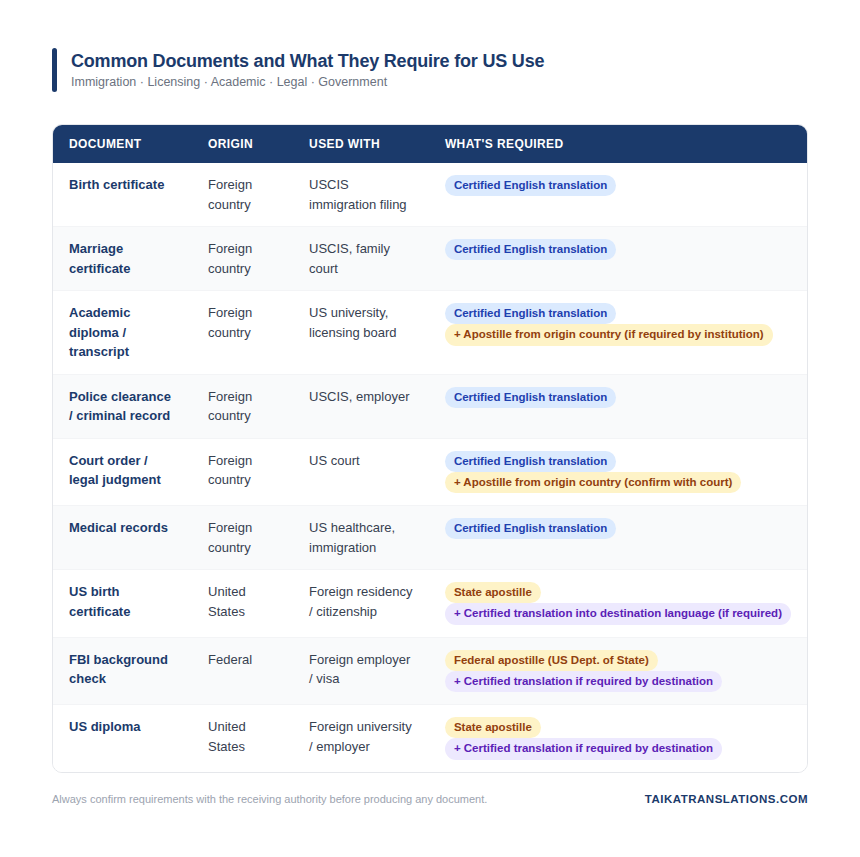
Certified translation is primarily for documents coming into the U.S. system. A birth certificate issued in Mexico, a marriage certificate issued in Brazil, a university diploma issued in India — these documents need to be translated into English and certified before they can be submitted to USCIS, a U.S. licensing board, a university, or a court.
Apostille is primarily for U.S. documents going out to other countries. A U.S. birth certificate being used to establish residency in Spain, an FBI background check being submitted to a German employer, a diploma being presented to a foreign university — these documents need an apostille so the receiving country's institutions can verify their authenticity.
This directional framework handles the majority of cases. The complication arises when a document needs to work in both directions, or when a foreign document needs to be apostilled in its country of origin before being brought into the United States. Some immigration workflows require both, in a specific sequence.
When You Need Both: The Sequencing Problem
The most costly mistakes in international document preparation happen when applicants need both an apostille and a certified translation but apply them in the wrong order or assume one replaces the other.
Here are the most common scenarios:
Foreign document submitted to USCIS: You need a certified translation. You do not need an apostille. USCIS focuses on complete, accurate English translation and translator certification. An apostille on the foreign document does not substitute for that requirement and is not requested.
U.S. document submitted to a foreign government: You need an apostille (if the destination country is a Hague member) or embassy legalization (if it is not). If the destination country requires the document to be in their language, you will also need a certified translation into that language, typically after the apostille has been attached.
Foreign document submitted to a U.S. licensing board or university: Requirements vary by institution. Many boards and universities require certified translation and may additionally require that the original foreign document carry an apostille issued by the country that originated it. Always confirm with the receiving institution before producing anything.
Immigration packets that include documents used internationally and domestically: These sometimes require both services applied to different documents within the same packet. A foreign birth certificate going to USCIS needs certified translation. A U.S. Certificate of Naturalization going to a foreign consulate in the same week needs a federal apostille. These are parallel workflows, not interchangeable ones.
The rule that applies in every case: the receiving authority's instructions control the process. Start with what the receiving institution requires, then work backward to determine which authentication route applies.
Why Machine Translation Fails in This Context
Certified translation for immigration and legal purposes requires human expertise that machine translation tools cannot provide.
The failure points are specific. Machine translation frequently mishandles formal legal register, drops context embedded in document structure, mistranslates technical vocabulary specific to civil records, and omits elements like stamps, seals, and handwritten notations that USCIS considers part of the document.
A birth certificate, an IEP document, a criminal record, and a university diploma each carry different vocabulary, different cultural context, and different stakes. A translator working in certified document translation for immigration understands not just the language but the document type, the issuing authority's conventions, and what information the receiving authority is looking for.
USCIS has returned translations as incomplete because a single stamp was not translated. Licensing boards have rejected transcripts because a course designation was paraphrased rather than translated verbatim. These are not recoverable errors in a time-sensitive application process.
How Taika Translations Handles Both
Taika Translations provides certified translation services for USCIS immigration filings, licensing boards, universities, and courts across the United States. Our translators are native speakers and subject matter experts in the document types they handle. Every translation is delivered with a compliant certification statement, word-for-word accuracy, and full rendering of all stamps, seals, and structural elements.
We work with a 2,000+ linguist network across 300+ languages, covering the full range of languages represented in U.S. immigration filings.
For organizations managing language access at scale — school districts receiving enrollment documents in multiple languages, government agencies processing applications from LEP communities, nonprofits supporting refugee and immigrant populations — we also build document translation workflows that handle volume without sacrificing the accuracy that compliance requires.
Taika holds NASPO ValuePoint Contract 17972 and the GSA Schedule, which means government procurement is already handled for state and local agencies.
To request a quote or discuss your document requirements, go to taikatranslations.com.
Quick Reference Summary
Apostille:
Verifies the authenticity of a document's signature, stamp, or seal
Required when a U.S. document is used in a Hague Convention member country
Federal apostille (U.S. Dept. of State) for federal documents; state apostille (Secretary of State) for state documents
Non-Hague countries require embassy legalization instead
The apostille itself does not translate the document
Certified Translation:
Provides a complete, accurate English translation with a signed certification statement
Required by USCIS for any foreign-language document submitted in immigration proceedings
Required by most U.S. universities, licensing boards, and courts for foreign documents
Does not authenticate the origin of the document
Notarization is not required by USCIS but may be required by other institutions
The most important rule: Start with the receiving authority's written instructions. They determine which service you need, in which order, before you produce or mail anything.
This article is for general education purposes and does not constitute legal advice. Immigration and authentication requirements vary by case, jurisdiction, receiving institution, and document type. Always review your specific requirements with qualified immigration counsel before filing.
Taika Translations, LLC is based in Austin, Texas and provides certified translation services for immigration, legal, academic, and government purposes across the United States. For inquiries: projects@taikatranslations.com