Cooperative Contracts vs. RFPs: How to Speed Up Compliant Purchasing
"We don't have time for another RFP."
It is a sentiment echoed in procurement offices across the country. Teams are understaffed, bandwidth is nonexistent, yet the mandate remains unchanged: stay compliant, stay within budget, and get the service delivered.
For many public agencies, the default reaction to a new need is to draft a new Request for Proposal (RFP). But an RFP is not just a document; it is a months-long cycle of needs assessments, drafting, legal reviews, vendor questions, evaluations, and potential protests.
There is a strategic alternative.
Cooperative purchasing allows you to leverage work that has already been done. By utilizing a NASPO ValuePoint Translation and Interpretation Provider, for example, you can bypass the administrative burden of a new solicitation while maintaining the highest standards of compliance and competition.
In this guide, we break down how cooperative contracts work, why they are not a "shortcut" around quality, and when you should—and shouldn't—use them.
What is a Cooperative Contract?
A cooperative contract is a commercial agreement that has been competitively solicited by a lead public agency and structured so that other eligible entities can "piggyback" on it.
Instead of 50 different states running 50 separate RFPs for the exact same service, a cooperative model asks: "Can we do one super-high-quality sourcing event, negotiate nationwide pricing, and let everyone else leverage that work?"
The NASPO ValuePoint Model
NASPO ValuePoint is the cooperative purchasing arm of the National Association of State Procurement Officials. It uses a transparent Lead State Model that ensures compliance at a level most local agencies cannot replicate on their own:
The Lead State: A single state (e.g., New Mexico for language services) conducts the formal competitive procurement.
The Sourcing Team: A multi-state team of experts helps design the RFP and evaluate proposals.
The Master Agreement: The winning vendors are awarded a Master Agreement.
Participating Addendum (PA): Your state signs a PA to adopt that Master Agreement, allowing local political subdivisions to use it.
Three Strategic Reasons to Choose a Co-op
Why would a procurement officer choose a cooperative contract over running their own local bid? It comes down to three factors: Efficiency, Leverage, and Expertise.
1. Efficiency and Speed
Your RFP costs your organization real money in staff time, legal review, and administrative overhead. It also costs vendors thousands of dollars to respond, often leading high-quality vendors to skip smaller, single-entity solicitations. By using a cooperative contract, you eliminate the redundancy of re-bidding a service that has already been vetted. You can often go from "identifying a need" to "issuing a purchase order" in days rather than months.
2. Better Leverage and Pricing
Cooperative contracts aggregate demand. A vendor like Taika Translations is more willing to offer aggressive pricing and enhanced service levels to a contract that serves hundreds of agencies than to a single small district. You gain the buying power of a state government, even if you are a small municipality.
3. Access to Category Expertise
Not every procurement team has a specialist for every category. You may not have a dedicated expert on "Language Access and ADA Compliance" or "Cybersecurity." When you use a NASPO ValuePoint contract, you are leveraging the expertise of a multi-state sourcing team that specialized in that specific category. They have already asked the tough questions about qualifications, security, and capacity so you don't have to.
Decision Matrix: When to Use a Co-op vs. RFP
Cooperative contracts are a tool, not a religion. The goal is to protect the public interest and use resources wisely. Use this comparison matrix to determine the best path for your project:
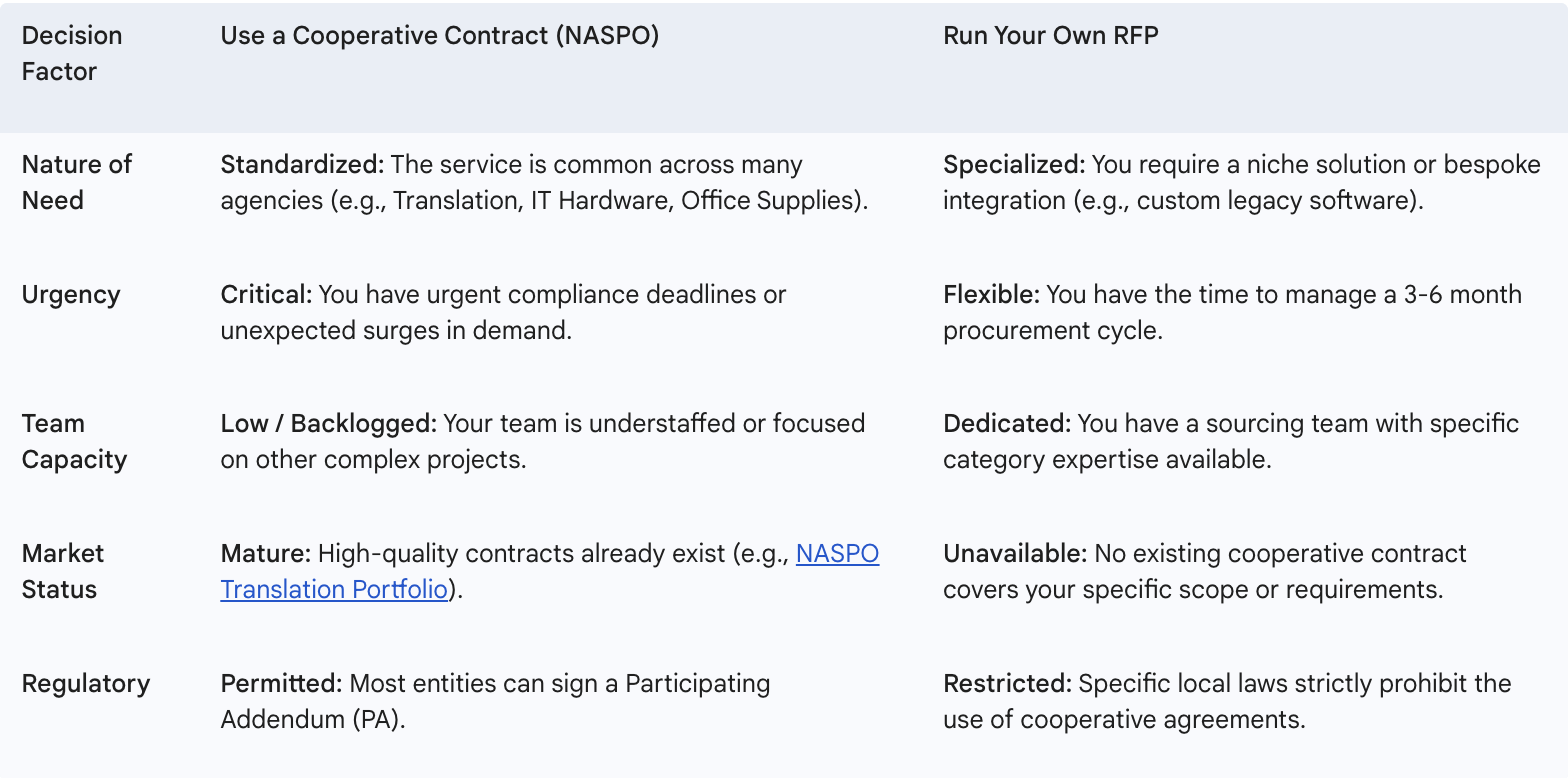
Decision Matrix: When to Use a Co-op vs. RFP
How to Get Started
If you have identified that a cooperative contract fits your needs, the process is straightforward.
Verify the Contract: Check if your state has a Participating Addendum with a NASPO ValuePoint Translation and Interpretation Provider like Taika Translations.
Review the Master Agreement: Ensure the scope covers your specific needs (Document Translation, OPI/VRI, Accessibility).
Contact the Vendor: Reach out to discuss your specific volume and onboarding needs.
Deep Dive: For a step-by-step guide on the mechanics of ordering, read our previous article: How to Buy Language Services via a NASPO ValuePoint Provider.
By shifting standard procurements to cooperative contracts, you free up your team’s bandwidth to focus on the complex, high-stakes projects that actually require your unique attention.
Ready to streamline your language access procurement? Contact Taika Translations to learn how we support public entities through NASPO ValuePoint Contract #17972.